
THLN Victories


Highlights of the Successful THLN Efforts to Protect Texas Animals through Advocacy, Education, and Legislation

happy puppyThe following are some highlights of the Texas Humane Legislation Network’s (THLN’s) successful efforts to protect Texas animals through advocacy, education, and legislation.  THLN has been fighting for animal protection since its inception in 1975. Click here to view the 2011 Legislative Session Report.

ANIMAL CRUELTY STATUTE AMENDMENTS

Some of the amendments to the State Animal Cruelty Statute that THLN has been involved with include:

  • A bill that increased the penalty for a third animal cruelty offense from a Class A misdemeanor to a state jail felony (SB 143, passed 1997).
  • A bill that increased the penalty for aggravated acts of animal cruelty from a Class A misdemeanor to a state jail felony, and from a state jail felony to a third degree felony on the third conviction (HB 653/SB 1724, passed 2001).
  • HB 2328 (passed 2007) makes it a felony to kill, administer poison to, or cause serious bodily injury to homeless dogs and feral cats. It also closed numerous loopholes in the existing Cruelty Statute, and lowered the mental state for proof of animal cruelty from intentional or knowingly to reckless, which makes proof of animal abuse much easier.  It also added the requirement of water to the list of required care elements for an animal in someone's custody.
  • THLN was instrumental in the passage of HB 963 (2011) which provides one common set of rules and requirements for appeals from all civil courts hearing cases involving the seizure and disposition of cruelly treated animals.  It also provides adequate security for restitution of the costs incurred by the government agency or non-profit organization in taking care of the animals during the litigation process and expedites the appeal process so that the animals are not held in limbo for extended periods of time.

ANIMAL FRIENDLY LICENSE PLATES

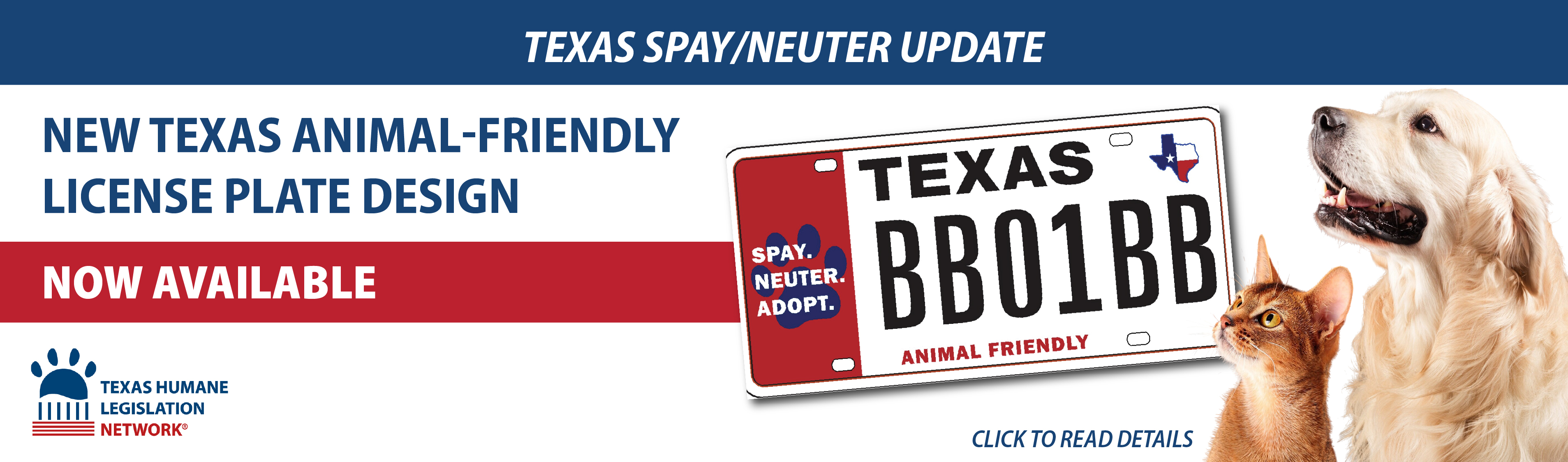
license plateThanks largely to THLN, this law (HB 3250, passed 1997) created a new "animal friendly" fund through the sale of special motor vehicle license plates.  Proceeds from the fund provide free and low-cost dog & cat spay/neutering to programs across the state.  The $3M allocated to the fund to date has resulted in the sterilization of 58,807 dogs and cats, which has prevented the future potential unwanted births of approximately 4 million cats and 1.5 million dogs (Texas Department of State Health Services, 2011).

THLN continually monitors the fund each legislative session to ensure that the monies continue to be used for their intended purpose and are not held back by the Legislature for any reason.

ANIMAL SHELTER REGULATIONS

Some of the humane animal shelter regulations which THLN helped establish include:

  • Humane regulations for non-quarantine animal shelters.  Prior to 1989, most shelters across the state had no regulations addressing feeding, cleaning, veterinary care, or separation of animals during impoundment as to species, size, or whether an animal was injured or sick.  The only regulations in effect were for shelters which quarantined animals for rabies. After THLN became involved, the quarantine shelter regulations (25 Texas Administrative Code §169.26) were extended to include all shelters in counties with populations 75,000 or greater. THLN attempted to extend the regulations to all shelters in counties of any size, but was unable to do so.  Later in 2005, THLN was able to extend the regulations to all public shelters, through the rulemaking process, after discovering a statutory provision requiring the Department of State Health Services (DSHS) to apply the quarantine rules to all public impound shelters. 
  • Dog/Cat Sterilization Act (HB 1226, passed 1993).  Before this Act became law, unsterilized animals could be adopted from shelters back out into the community, clearly contributing to the pet overpopulation problem.  Now the law requires all dogs and cats to be sterilized before they are adopted from public and private animal shelters. (So far, does not apply to shelters located in counties with populations of 20,000 or less, or municipalities with populations of 10,000 or less.  THLN will continue to work to reduce the population bracket so that all shelters are covered.)
  • Humane Euthanasia Act (SB 572/HB 1115, passed in 2003).  Prior to this Act, shelters were killing dogs and cats by drowning, shooting, clubbing, strangling and by carbon monoxide poisoning from truck and car exhausts hooked up to makeshift plywood boxes.  The law now mandates that one of only two methods can be used:  sodium pentobarbital injection, or commercially compressed carbon monoxide administered in a commercially built chamber.  The law now also requires training for euthanasia technicians.

catFor years before this law came about, THLN fought to bring an end to "gas chamber" euthanization in the state.  However, the Texas Department of State Health Services (DSHS, the state agency which oversees animal shelter euthanasia) maintains that gas chambers must continue to be an option because of the large number of Texas animal control agencies which employ only one individual.  DSHS feels two individuals are required to correctly and humanely administer the injectable euthanasia solution.

Based on these arguments, the Texas Legislature continues to allow gas chambers to be used in shelter euthanasias.

Click here to see a list of things YOU can do to help bring an end to Texas animal shelter gas chambers.

THLN has long sought to address the issue of gas chambers with the DSHS and will continue to work tirelessly toward gas chamber elimination.

COCKFIGHTING

roosterTHLN worked closely with the Texas Animal Control Association and the Humane Society of the United States in passing HB 1043 to strengthen the cockfighting laws in Texas.  In addition to cockfighting itself, HB 1043 outlaws promoting a cockfight; allowing one's property to be used for a cockfight; training fighting birds; and attending a cockfighting event.

DANGEROUS PET & BREED SPECIFIC LEGISLATION

THLN successfully opposed the proposed regulation of "dangerous" pets (SB 349, 2007).  The subject bill was far too broad and gave no criteria for what is or is not a dangerous pet.  The "dangerous" designation would have been left to the discretion of the county commissioners' court and could have lead to abuses of power and to breed specific legislation.

DANGEROUS WILD ANIMALS

tigerIn 2001, THLN was instrumental in passing HB 1362 which requires owners of dangerous wild exotic animals (such as lions, tigers, leopards, bears, great apes, etc.) to register those animals with their local animal control authority and provide those animals with housing and care in accordance with minimum standards set forth in the bill and the rules and regulations adopted thereunder.  It also allows counties and municipalities to further regulate or totally ban the ownership of these animals.  Prior to the passage of this legislation, several children were mauled and either killed or seriously injured by these animals primarily as a result of their irresponsible owners.

DOG FIGHTING

pit bull dog imageTHLN was instrumental in getting dog fighting outlawed in the state as well as later strengthening the statute to increase penalties for various offenses.

  • The Dog Fighting Act, passed in 1983, outlaws dog fighting, promoting a dog fight, training dogs to fight, and attending a dog fight.
  • The Dog Fighting Penalty Enhancement Bill increased the punishment for dog fighting from a Class A misdemeanor to a state jail felony, and increased the punishment for attending a dog fighting exhibition from a Class C misdemeanor to a Class A misdemeanor (HB 916, 2007).
  • The Dog Fighting Classified as Organized Crime Bill was passed in 2009 (SB 554).  It allows dog fighting to be classified as organized crime and additionally allows for the forfeiture of all property including cash, vehicles, etc. associated with dog fighting.

HORSE SLAUGHTER

horseSince 1949, Texas law has prohibited the sale, possession and transportation of horse meat for human consumption, yet for decades this law was ignored as two foreign-owned plants slaughtered thousands of Texas horses annually for horse meat consumption overseas.  The plants operated in Fort Worth (Beltex) and Kaufman (Dallas Crown). 

A THLN attorney investigating ways to get horse slaughter banned in the state discovered that it was already illegal via the previously mentioned law.  At THLN's request, Representative Tony Goolsby (R-Dallas) asked Texas Attorney General John Cornyn to issue an opinion as to the enforceability of the 1949 statute.  Cornyn's opinion (August 2002) confirmed that the 1949 law which bans live horse slaughter for human consumption is applicable and enforceable.

Following Cornyn's opinion, Beltex and Dallas Crown sued in federal court to block prosecutors from closing down their plants.  A 2007 federal appellate court eventually upheld the original 1949 statute, and the plants were forced to close.

HB 2476 to legalize horse slaughter was introduced the same year (2007), but died in committee. An amendment that would have effectively done the same was tacked on to a Senate bill without clarification, but was removed by House members. 

THLN continues to monitor legislation throughout each session to guard against any new attempts to legalize horse slaughter for human consumption.

HORSE TRIPPING

horseHorse tripping is the horrific practice of roping the front or hind legs of a full-on galloping horse and causing it to trip and come crashing to the ground, all for the purposes of entertainment or sport (www.ahdf.org).  THLN successfully advocated for the addition of an amendment to the state Animal Cruelty Statute which effectively bans horse tripping (SB 15, passed 1995).

PET EVACUATION BILL

The Pet Evacuation Bill (HB 88, passed in 2007) requires that all companion and service animals be included in evacuation plans in the event of a natural disaster.  Previously, evacuees had to either abandon their pets or leave them at local emergency shelters during natural disasters.

PUPPY MILL REGULATION

no puppy millsIn 2011, THLN was instrumental in passing HB 1451 which licenses and regulates large scale commercial dog and cat breeders (those having 11 or more intact females and selling 20 or more puppies or kittens per year).  HB 1451 provides basic protections for tens of thousands of dogs and cats confined and raised in large scale breeding facilities by requiring humane housing and care standards and needed veterinary care.  The law will be administered and enforced by the Texas Department of Licensing and Regulation and will require periodic inspections and annual veterinary care.  Those breeders required to register must do so by September 1, 2012 and meet all required standards prior to registration.

ROADSIDE SALES OF LIVE ANIMALS

catTHLN's work on this bill (SB 254, passed in 2007) helped tighten up regulations governing roadside sales of live animals.  Prior to 2007, commissioners' courts in counties with a population of 2.2 million or more were authorized to regulate the sale of animals on a public highway or road, in the right-of-way of a public highway or road, or in a parking lot in the unincorporated area of the county.  Through THLN's efforts, the size county to which this law applies was reduced from 2.2 to 1.3 million or more, which gives smaller counties like Bexar and Tarrant the authority to regulate these activities.

THLN on Facebook THLN on Twitter THLN on YouTube Share This Site With A Friend! THLN Site-wide RSS Feed

GET BLOG POSTS IN EMAIL!
Enter your email address.


RSS Email Service by Blogtrottr.com